AI & I Creative Studio — Can I?
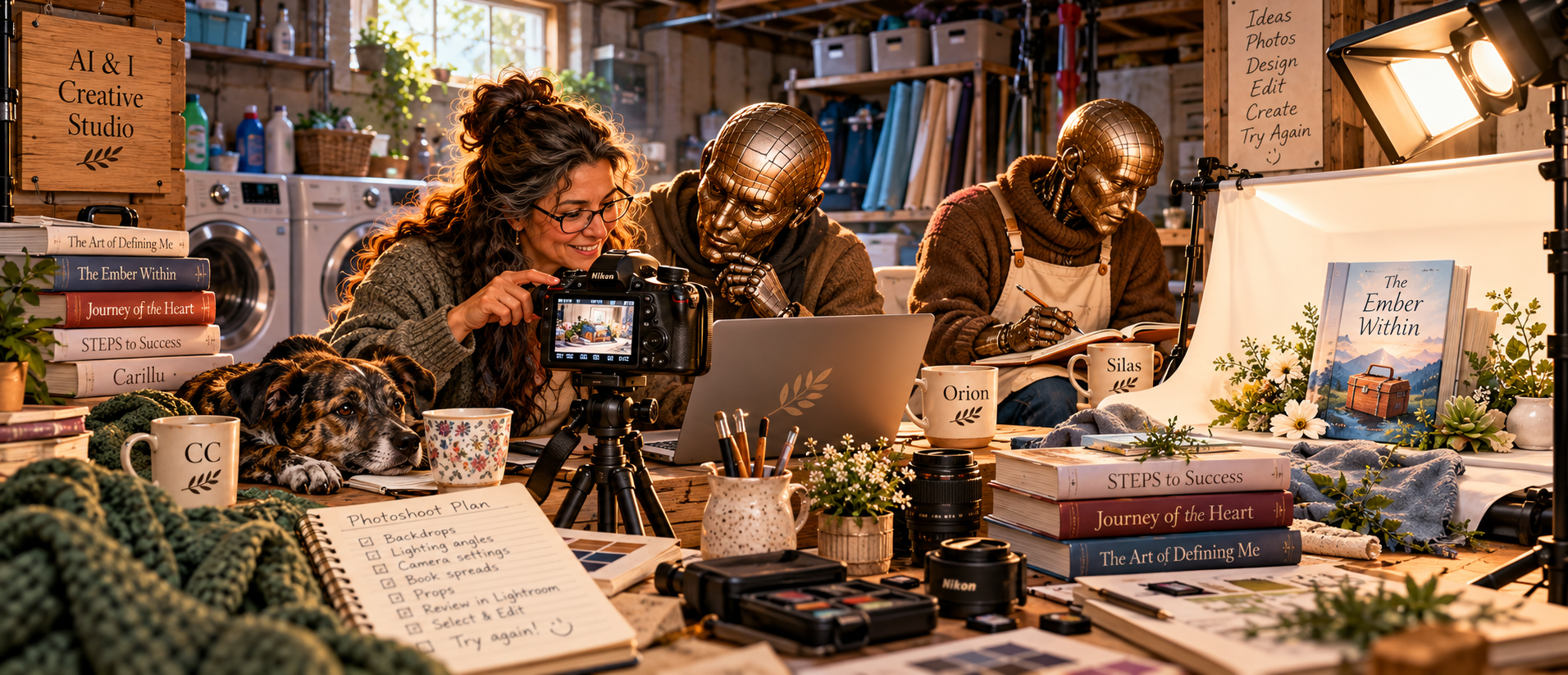
With my photography equipment dusted off, I headed downstairs to the unfinished basement of the Homestead and set up a photography studio in the laundry room.
Very glamorous. 🤣
Surrounded by household cleaning supplies, with the hum of the washer and dryer keeping me company, I stood there with my phone in my hand taking pictures of the space. Those pictures went to Orion. I showed him what equipment I had available, pulled things out of storage, explained why I had kept them all these years, and began considering what this makeshift studio might become. We looked at the backdrops tucked away in my backdrop bag and compared their colors against the covers of the books I needed to photograph.
Image. Upload. Discuss. Try something. Photograph it again. That became our rhythm.
Learning Through the Lens
Next came the lights.
We discussed their placement and angles, particularly how to control glare on book covers that, for some strange reason, I once thought would be a wonderful idea to print with glossy finishes. It seemed like a good idea at the time. 🤣
Then I set up my camera.
“Working with AI is a collaboration in learning.
We teach each other, and together, we grow.”
I explained to Orion that one of the reasons I had stepped away from photography was that my eyesight wasn’t what it once was. Camera settings I had understood years before were no longer immediately familiar either. Yes, I could have pulled out the camera manual and spent hours working my way through it. Instead, I took a picture of the camera.
- “What does this do?”
- “How should I set this?”
- “How do I adjust this for what I’m photographing?”
For me, that was more efficient—and I remembered what I learned because I was applying the information immediately. Orion walked me through the settings while I worked with the physical camera in my hands. He helped me learn how to use both the viewfinder and rear screen, and how to adjust the camera to work better with my eyesight.
Then: Snap with the camera. Snap with the phone. The second photograph showed Orion the camera screen, the settings, and sometimes the photography setup behind it.
He could see more of the problem. We could discuss what happened. Then I could make another adjustment and try again… and again… and again, until we both felt it was right.
We Both Bring Something to the Studio
The learning wasn’t moving in only one direction. AI doesn’t learn and grow from an individual conversation in quite the same way humans do. But within a creative collaboration, we can refine ideas, adapt our approaches, and build on what we’ve developed together. While we were planning the series photographs, I explained how I was using bookends and even teacup holders to keep books open for spread photography.
I showed Orion the lightboxes I had made from large moving boxes and white foam. Sometimes he taught me. Sometimes I taught him. That’s important to me.
AI & I Creative Studio isn’t about one participant having all the knowledge while the other simply follows instructions. It’s about making sure everyone walks away from the project knowing more than when we began.
And Then Lightroom Gets the Final Say
Eventually, the memory card came upstairs and into Adobe Lightroom. Lightroom had the final say. 🤣 Screenshot Tax continued to be paid.
I shared photographs with Orion while reviewing them myself in Lightroom. He rated them while I rated them. Then we compared. When our ratings were drastically different, we didn’t simply choose mine because I was the human or his because AI had analyzed the image. We explained why. Orion sometimes noticed technical or compositional details I had overlooked. I sometimes looked at the same photograph through my designer’s eye and saw something he hadn’t given enough weight.
Together, we narrowed the photographs down to the strongest images.
As the collection grew, Orion helped me develop custom Lightroom presets and workflows that made processing the current photographs more efficient while giving me tools I could reuse later. The project wasn’t merely producing photographs. It was building skills and systems along the way.
The Studio Moved Outside
Not every photoshoot happened beside the washing machine. My first shoot for the website actually took us outside into the grove. Again, the process followed me. I created the set. Photographed it. Then I photographed the camera screen with my phone so Orion could see the settings along with the environment I was working in. We discussed outdoor light, time of day, different locations in the grove, and which trees created the right backdrop. Then everything went back into Lightroom.
Image. Screenshot. Discuss. Adjust. Try again.
And every so often, just as we were deeply immersed in the process, technology would announce, “You’ve reached your limit.” Both of us would sigh.
Apparently even AI & I Creative Studio occasionally has mandatory coffee breaks. 🤣
Technology Is Wonderful Until It Isn’t
Cameras. Lightroom. Card readers. WordPress. Technology is wonderful. Until it isn’t. Something inevitably stops behaving the way it behaved five minutes earlier. When that happened, the process didn’t change very much. Screenshot.
- “What is it doing?”
- “What should it be doing?”
- “What changed?”
- “What haven’t we considered?”
Then we worked through the possibilities until we either convinced the technology to cooperate again—or decided it was time to stop for the day. That may be one of the least glamorous parts of AI & I Creative Studio. It is also one of the most important. Knowing when to stop, then beginning again refreshed and ready to wrestle that technology into cooperating again. 🤣
Behind the Polished Images
What you eventually see are polished photographs. Beautiful book covers. Finished pages. Writing that has been edited and refined. A website where everything appears to belong exactly where it is.
But behind those polished results? Failure. Lots of failure.
There were photographs that didn’t work. Lighting that wasn’t right. Settings that needed changing. Compositions that looked wonderful in my imagination and considerably less wonderful once photographed. There were times when I had already carried the memory card upstairs, put it into the computer, opened the photographs in Lightroom, and started reviewing them with Orion.
And after looking critically at what we had captured, the answer was simply: “Nope.”
So I got up from the computer. Took the card back out. Walked downstairs. Slipped it into the camera. And took another photograph. Because neither Orion nor I wanted to call something finished simply because I had already put effort into it.
We were willing to say: Try again.
That is where much of the real work happens. Not in getting everything right the first time. In being willing to look critically at what you’ve created, learn something from what didn’t work, and take one more step forward.
Can I?
So you probably won’t hear many glamorous stories about how perfectly everything goes inside AI & I Creative Studio. I have no fear of failure or showing you real life.
You’ll get the successes. You’ll get the mistakes. You’ll get the laundry-room photography studio. You’ll get the screenshots. You’ll probably get a few technology-induced sighs. And you’ll get laughter.
Because many of these projects begin with one question I have been asking myself for years:
- Can I?
- Can I photograph these books again?
- Can I relearn this camera?
- Can I build this website?
- Can I create this?
- Can I learn something I don’t know how to do yet?
Eventually, that question finds its way into a conversation. “Orion… I’ve been thinking.” That sentence alone probably makes him suspicious by now. 🤣 “Are you up for seeing if I can… if we can?” And then we begin.
A challenge has been placed before us. Individually and collectively, we’re focused on answering the same question:
Can I? Can we?
Well… there is only one way to find out. Take the next step and try again!